
Category: Academic
Higher Education Renovation Project Awarded Silver Citation in the 2015 American School & University Educational Interiors Showcase
SCHRADERGROUP (SG) is pleased to announce that the renovation of the Rollins Advising and Transfer Center at Bucks County Community College in Newtown, Pennsylvania, was awarded a Silver Citation in the 2015 American School & University Educational Interiors Showcase, the premier competition honoring education interiors excellence.
Commenting that a “Clean, simple, modern color palette heightens the redesign of previously dark and underutilized spaces,” the jury selected the renovation as one of the 77 projects to be featured in the Educational Interior Showcase.
For the project, design services were provided for the renovation and conversion of approximately 4,300 SF of undefined space lacking in program within Rollins Hall into an Advising and Transfer Center. The space primarily is dedicated to student counseling and includes a suite consisting of small, flexible office spaces for advising functions.
The design features movable acoustical partitions as well as sliding and folding glass partitions to allow for flexibility and adaptability. Additionally, movable furniture fosters side-by-side collaboration by student and counselor. Other spaces included as part of the program include Director and Assistant Director offices, a Conference Room, and a larger Computer Room or training center for approximately 20 students. The space also integrates an existing fireside lounge feature along with small tables and comfortable seating scattered throughout to provide multi-function breakout spaces.

The design for the Center serves an important role in promoting a sense of identity for the College and is responsible for creating a welcoming first impression for visiting potential students. Mechanical, electrical, technology, and security system upgrades were also included as part of the project scope.
To see more images of the Rollins Advising and Transfer Center project, please visit American School & University Educational Interiors Showcase or our website.
SCHRADERGROUP Co-sponsors CEFPI School of the Future Competition, Managing Principal Chairs Jury
SCHRADERGROUP (SG) was proud to be one of the sponsors of the CEFPI School of the Future Design Competition, an annual event open to middle school students that challenges student teams to design learning environments to enhance learning, conserve resources, be environmentally responsive and engage the surrounding community. The multi-disciplinary solution developed requires students to follow a planning process from the concept phase to completion of the project, with thorough documentation.
Over 3,000 students representing nearly 100 school districts in North America and the United Kingdom took part in the 2014 program, whose main sponsor is the Council of Educational Planners International (CEFPI).

Students present their project at the CEFPI School of the Future Design Competition
SG Managing Partner, David Schrader, served as jury chair at this year’s event. “Chairing the jury affords me one of the best days of the year,” commented David. “Creating schools that inspire changes in education, empower students and engage the community, these young designers demonstrated great passion, enthusiasm, remarkable research and exceptional teamwork. Our future looks much brighter with them at the helm.”
A long-standing member of CEFPI, David presently serves as Chair-elect of the International Board of Directors for the organization. Former CEFPI posts include Chair of the International Membership Committee, Chair of the School of the Future Design Competition, and President of the Northeast Region.
To learn more about CEFPI and the School of the Future Design Competition, please visit www.cefpi.org.
Early Learning Center and Elementary School Project Receives Citation from American School & University Architectural Portfolio
SCHRADERGROUP (SG) is pleased to announce that our Early Learning Center and Elementary School new facility design for Phoenixville Area School District, Phoenixville, Pennsylvania, is the recipient of a Citation for Work in Progress by American School & University Architectural Portfolio, the premier showcase celebrating the best in education design.
One of 127 projects selected to be featured in the Architectural Portfolio issue, the Early Learning Center and Elementary School project was recognized by the jury for its “excellent expression of small learning communities balanced with heart of school,” as well as the “unique focus on food and nutrition as part of learning experience.”

Main entry.
The new 152,000 SF Early Learning Center and Elementary School is designed to support two specific grade structures in a “school within a school” format: K-1 in an Early Learning Center, and 2-5 as an Elementary School. The building design promotes essentially every space in the facility as learning space.

Small group area outside of learning studios.
A primary goal for the facility is to create a focus on literacy and learning in a non-standard learning environment. In response, the design places the media and technology center at the core of the facility with all other functions radiating from it.

View of the Learning Resource Center from the second floor.
To learn more about our Early Learning Center and Elementary School project, please visit our website.
SCHRADERGROUP Principal Published in School Planning & Management
An article authored by SCHRADERGROUP (SG) managing principal David Schrader was featured in the August 2014 issues of School Planning & Management magazine. The article, entitled “The Real Question,” brings to light the question of what 21st century learning environments will encompass. David, both locally- and nationally-recognized for his contributions to planning and design for education, and a leader in the Council of Educational Facility Planners International (CEFPI), discusses the differences between the educational models developed at the beginning of the 20th century and those required for today’s learner.

21st Century Learning Environments: (left) Team project spaces following the lead of high-tech firms; (right) a learning studio cluster with integral project, maker and presentation spaces. [Renderings by SG]
SCHRADERGROUP Attends Groundbreaking for Two New Elementary Schools
SCHRADERGROUP (SG) was pleased to be in attendance at the groundbreaking ceremonies for two new elementary schools to be constructed in the Bristol Township School District (BTSD). In 2012, SG was engaged by BTSD to complete a District-Wide Feasibility Study that included existing facility assessments of nine elementary schools, three middle schools, and a high school. After extensive evaluation of options and District cost impacts, it was determined that three new elementary schools would be developed to replace the nine existing and aging elementary structures.
Since then, SG developed designs for the three new elementary schools. The recent groundbreaking ceremonies kicked off construction for the new James Buchanan Elementary School and the new Ralph Waldo Emerson Elementary Schools. Construction on the third new school, Mary Devine Elementary, is slated to begin in later this summer.
The existing District school facilities have been in service for over sixty years. All were originally established as part of the post-war development founded by Bill Levitt as part of the accordingly named Levittown. Long overdue for facility updates, the District now will have the ability to offer 21st century learning environments to the population to support their 21st century education program.
“It’s been an incredibly exciting experience to contribute to this next generation of school facilities for the District,” says firm principal David Schrader. “This is what we are all about – creating the best learning environments possible to meet the needs of today’s students. We are thrilled to see this happening in Bristol Township School District.”

SGA principals Bruce Bachtle and David Schrader, along with Project Architect Dan D’Amico (far right of photo), join administration, faculty, and staff of Bristol Township School District at the groundbreaking.
SCHRADERGROUP Principal Takes Part in ‘Building for Achievement’ Charrette
SCHRADERGROUP (SG)’s Managing Principal, David Schrader, was invited by Tacoma Public Schools to participate in their ‘Building for Achievement’ Guiding Principles Charrette. Tacoma Public Schools, Tacoma, Washington, is a progressive and innovative school system that sets goals high for both their students as well as the leaders of the school system itself. A $500 million bond issue in 2013 is allowing the District to focus on a number of modernization, new construction and smaller capital projects for their schools. Although winners over the past decade of numerous design awards for their facilities, Tacoma Public Schools wants to continuously challenge their approach to how they teach and how they operate their facilities, as well as to better understand how their students want and need to learn. To do this, they regularly conduct events such as the Guiding Principles Charrette – an intense two-day design workshop involving representation from various segments of the District as well as members of the professional community such as architects, engineers and industry partners.
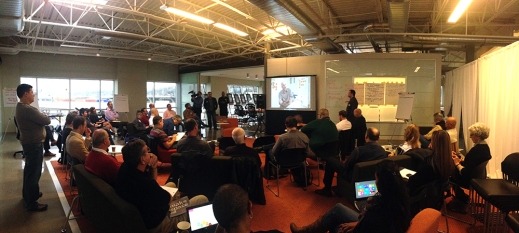
‘Building for Achievement’ Guiding Principles Charrette
SG Managing Principal David Schrader, nationally-recognized for his contributions to design for education and a leader in the Council of Educational Facility Planners International (CEFPI), was honored to participate. Greatly inspired by the event, David said, “In this process, everybody gets together and is actually open to the discussion. All of these designers are letting their cats out of the bag, so to speak. They’re talking about their thought process which, in the end, will turn into learning environments for the kids. This is really exciting to be a part of it.”
Congratulations to David for being invited to take part in such an exciting event!
SCHRADERGROUP exhibits at PASBO Annual Conference
We were pleased to once again exhibit at the Pennsylvania Association of School Business Officials (PASBO) Annual Conference in Hershey, Pennsylvania, on March 12-13. For a number of years, we watched school administrators face reduced spending and then, later, a state moratorium on funding projects. We knew Districts were challenged to maintain schools at desired levels, and frustrated by the inability to do anything new. We’re pleased to report, however, that at this year’s conference, we couldn’t help but notice a little optimism in the air. “It seemed as if the conference had a rejuvenated feel and atmosphere,” said SCHRADERGROUP (SG) firm principal Harry Pettoni. We hope this is an indicator of better times to come for the school districts of Pennsylvania.
Today, 21st Century Learning Environments serve as the pinnacle of our education system and provide the way in which our students are trained to be competitive in our ever changing society. As a leader in design for 21st Century Learning Environments, SG continues to be recognized for our innovations in educational planning and design and for continually striving to better ourselves and the world around us through thoughtful facility design and planning.
Our focus remains on the “Learner” and on constantly furthering our understanding of how each student learns best. We do not just respond to current research on learning – we often are called upon to help create and shape it. For our clients, this translates to a commitment to contribute our passion and drive for continuous improvement and to integrate our research and expertise into every conversation we have. Together, we explore and discover what best serves each learning environment. Recent trends are leading to the development and implementation of STEM or STEAM schools to allow students to become creative innovators, critical thinkers, problem solvers and thought leaders. STEM and STEAM schools demand these skills. Are your facilities prepared for the next shift? (For additional information, please contact hpettoni@sgarc.com).
Smart Planning at Work
In July, we posted an entry that focused on empowering school districts through intelligent planning. We touched on our recent commitment to a Pennsylvania school district, Bristol Township School District (BTSD) in Levittown, to complete a district-wide assessment and feasibility study. The study led to some remarkable achievements that perfectly illustrate smart, targeted planning at work.
Identifying the Issues
Collaborating with SCHRADERGROUP (SG) on a District-Wide Feasibility Study that examined conditions at nine elementary schools, three middle schools and a high school, BTSD faced some hard facts about the state of the facilities in the District. Three things became quite clear:
- The District’s current facilities are deteriorating and increased costs will be incurred long-term for each year that maintenance-only upgrades are implemented.
- The District will soon experience an issue with increased enrollment.
- Replacing and strategically renovating the District’s facilities presently will yield future savings that will enable the District to afford 21st century learning environments and additionally will aid in enhancing property values in the District.
The District also wisely realized that time was a factor, and that acting swiftly would allow them to take advantage of state reimbursement opportunities, historically low interest rates, and a diminishing debt service for previously completed projects.
Determining Optimal Solutions
The facility assessments and feasibility study conducted by SG, combined with information gained from an independent demographics analysis, led the District to a conclusive direction for major District-wide capital improvements. After extensive evaluation of multiple options and District cost impacts, it was determined that three new elementary schools would be developed to replace the nine existing, aging elementary structures. What makes this exceptionally noteworthy is that the work could be completed with NO increased tax burden to residents.
As a result of smart planning, the District was able to formulate a strategy that boasted many advantages, a few of which include:
- Replacing aging, inadequate facilities with new facilities offering 21st century learning environments
- Accommodating projected enrollment increases
- Reducing operating costs
Implementing the Plan
When the District elected to move forward, SG was retained to begin work on the design of the three new elementary schools. Following an intensive community-based planning process, design of the three new schools is well underway. SG is pleased and proud to be a part of the endeavor and looks forward to delivering to BTSD cost-effective, energy efficient, 21st century facilities that meet today’s and tomorrow’s needs for students, faculty and the community as a whole.

Prototype design for three sister elementary schools in Bristol Township School District.
Integrating Architecture and Structure: A Cross-Discipline Approach
Too often, the role of structural engineering in the architectural design process is reactive. This is an unfortunate reality since these two disciplines are so closely related. So much so that, in the building design realm, one does not exist without the other.
In many instances, planning and design advances beyond the programming stage to the point where an entire facility plan is on paper with little or no input from the Structural Engineer. While this isn’t necessarily beyond the point of no return, the Structural Engineer usually has two choices:
Make It Work – this path often leads to inefficiency, unnecessary complexity, and additional costs.
Change It – while this path may lead to a better design, it can require a significant amount of backtracking and rework.
Of course, design development is an iterative process. However, the better approach is for the Structural Engineer to become immersed in the project from inception. Getting involved at the first stages of programming discussions with Owners and end-users allows the Structural Engineer to be engaged in the conceptual development of the overall plan at a time when their input is highly effective and purposefully influential.
‘At the beginning’ is the best time for the Structural Engineer to provide insight for the big-picture decisions that are part of every project; decisions that have a major impact on form, function, cost, and constructability. Many factors require thoughtful consideration and, if left unattended for too long, can have a negative impact on the process. Waiting until the Owners have bought into the design is not a reasonable or beneficial methodology.
Creative is one of the more powerful and influential words used to define an Architect or the process of Architectural Design. How often are Structural Engineers defined in the same manner? Not very often, I would surmise. But the true answer is driven by their extent and timing of integration into each project. If they’re a late arrival to the process, numerous constraints may already be in place, limiting their creative freedom. With early involvement, their creative potential is much broader and will have a more positive impact on the project as whole.
Yes, the discipline of structural engineering can be rigid, formulaic, and is always constrained by material strengths and the immutable laws of physics. However, there are almost always multiple solutions to every problem. Early involvement ensures that many of these potential solutions remain viable and that a consensus approach to a final solution is made. There is no better time to make the right decisions than during the conceptual sketch-planning stages of development.
The collaborative team mindset between the Architect and Structural Engineer is crucial at the very onset of each new project. Efficient, cost-effective, and highly sustainable buildings are always desirable goals. Achieving these goals requires that the Architect and Structural Engineer work together from day one. Both the Architect and the Structural Engineer are highly trained and skilled participants, each with a different knowledge base that must be integrated for successful results.
Written by Thomas Forsberg, PE, Structural Engineer and Principal at SCHRADERGROUP
Empowering School Districts through Intelligent Planning
At SCHRADERGROUP (SG), we know targeted planning initiatives can lead to the successful resolution of issues that so often beleaguer school districts. Our twenty-five years of innovative planning experience allow us to lead districts through a comprehensive master planning process that includes assessing current conditions, identifying problem areas, and determining feasible options that deliver flexible, cost-efficient and enduring solutions.
For example, we recently helped a Pennsylvania school district to complete a district-wide assessment that led to the planning and design of three new, state-of-the art elementary schools to replace nine ailing elementary buildings. What is remarkable about this achievement is that the new schools will be completely financed within current district spending and will result in a net-zero cost difference to the district tax payer. As a result of intelligent planning, the district is able to achieve a proper distribution of the current student population, accommodate projected enrollment increases, reduce operating costs, and provide three new 21st century learning environments.

A prototype design for a state-of-the-art elementary school. Three new buildings of this caliber will replace nine ailing facilities as a result of smart planning.
Planning efforts are a relatively small investment to make, particularly when considering the potentially powerful impact of the outcome. To remain vital, districts must make decisions that best serve students, faculty, and staff, as well as their communities. Smart planning empowers districts to move forward with purpose and direction, making the very most of the resources available and achieving the most optimal results for the district as a whole.